Stocastic_process
随机过程 Markov Chain
没有严格的分章节
想要回答的问题:
- Markov Chain definition
- N_step transition
- \( \lim_{n \to \infty} P(X_n = i) \) Markov Chain Basic Limit Theorem of Markov Chain
- Regular Matrix
- Doubly
- Reducible
- Time Reversible
- General Function
Markov Chain definition
首先,默认所有的vector都是row vector。
Markov Chain:
\[p_{i,j} = P(X_{n+1} = j | X_n = i) = P(X_{n+1} = j | X_n = i, X_{n-1} = i_{n-1}, X_{n-2} = ....P(X_{n+1} = j | X_n = i) )\]所以是从下标第一个到第二个,对应的从列到行;
Matrix Notation: \(\begin{align*} \left[ \begin{array}{ccc} P_{1, 1} & \cdots & P_{1, 2}\\ \vdots & \ddots & \vdots \\ P_{2, 1} & \cdots & P_{2, 2} \end{array} \right] \end{align*}\)
记住,是从列map到行。
最经典的Random Walker 的例子:
\[\begin{align*} \left[\begin{array}{ccc} 1 & 0 & 0 & \cdots \\ q & 0 & p & 0 \\ 0 & q & 0 & p \\ \vdots &\vdots &\vdots &\vdots \end{array} \right] \end{align*}\]所以这样的话,每一行的和都是 1。 \( \displaystyle for\ i \in \mathcal{S}: \sum_{j \in \mathcal{S}} P_{i,j} = 1\)
Doubly Stochastic Matrix P
All column sums are 1. \( \displaystyle for\ j \in \mathcal{S}: \sum_{i \in \mathcal{S}} P_{i,j} = 1\)
e.g.: \(\begin{align*} \left[\begin{array}{ccc} \boxed{0.1} & 0.9 \\ 0.9 & 0.1 \\ \end{array} \right] \end{align*}\)
其实只有1个free variable, 所以,M x N 只有 (M-1) x (N-1) 个free variable。
相当于,每一个state的进入机会都是相等的,没有偏重。
Matrix:
if \(P\) & \(Q\) are both doubly stochastic matrix. \( \lambda P + (1- \lambda) Q \) & \(PQ\) is also a doubly stochastic matrix.
Property: If a doubly stochastic matrix P is regular then:
- limiting distribution exists.
- Hence stationary distribution exists.
- It is (1,1,…,1)/M. (Uniformly distributed)
Regular
All elements are strictly positive.
Null-recurrent & Positive recurrent (Class property)
Null-recurrent only possible for infinite state.
Positive recurrent: If starting at state i, the expected time when MC returns to sate i is finite.
why is a class property (lecture 12 -10+)
Irreducible
All state is in one equivalence class. (All state are connected)
If a finite Markov chain is irreducible, then every state is of the same period; and all states are recurrent. (Finite Markov chain should at least have one recurrent state, infinite Markov chain doesn’t e.g. 3-D random walk)
Return probability \( f_i\)
\(f_i := P(X_n = i \text{ for some }n \ge 1 | X_0 = i).\) The probability when MC stats at i and will ever return to i.
Recurrent & Transient
\(\begin{align*} \text{transient} &\iff f_i < 1 &\iff \sum_{n = 1}^{ \infty} p_{i,i}^{(n)} < \infty \\ \text{recurrrent} &\iff f_i = 1 &\iff \sum_{n = 1}^{ \infty} p_{i,i}^{(n)} = \infty\\ \end{align*}\)
This is also a class property. (lecture 10)
Period
The period of state \(i\) denoted by \(d_i = GCD { n \ge 1: p_{i,j}^{(n)} > 0 } \).
This is also a class property.
Aperiodic
Every state is of period 1 is Aperiodic.
N-th step transition
2 step case:
\( p_{i,j}^{(2)} \) =? 从 \(i\) 出发,第二步到 \(j\) 的概率。
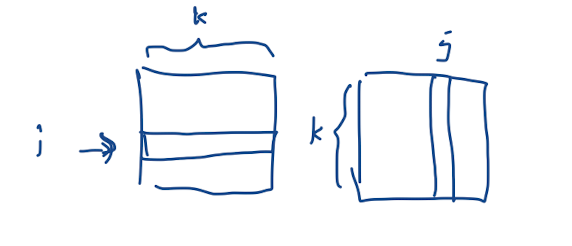
所以 \( PP = P^2\). 这样的话 \( P^2_{i,j}\) 就直接是走两步了。
所以
Chapman-Kolmogorov equation\(P^{m+n}_{i,j} = \sum_{k \in S}^{} P^{(m)}_{i,k} P^{(n)}_{k,j}\) \(P^{(m+n)} = P^{(m)} P^{(n)}\)
Markov Chain Basic Limit Theorem of Markov Chain
An irreducible, aperiodic and positive recurrent Markov chain. Has a unique solution of the static distribution.
\[\begin{align*} \lim_{n \to \infty} p_{j,j}^{(n)} &= {\frac{1}{E(T_j|X_0 = j)}}\\ \pi_j &= {\frac{1}{E(T_j|X_0 = j)}} \end{align*}\]To compute the limiting distribution
\(\begin{align*} \pi_j &= \sum_{i \in S}^{} \pi_i p_{i,j} \\ \end{align*}\)
Regular Matrix
Doubly
Reducible
Time Reversible
Time reversible, stationary Markov chain:
\[\forall i,j \in \mathcal{S}, \tilde{p}_{i,j} = p_{i,j}\] \[\begin{align*} P(X_m = j| X_{m+1} = i) &= {\frac{P(X_M=j,X_{m+1} = i)}{P(X_{m+1} = i)}} &= {\frac{ \pi_j p_{j,i}}{\pi_i}} \\ \end{align*}\]Or equivalently detailed balance equation.
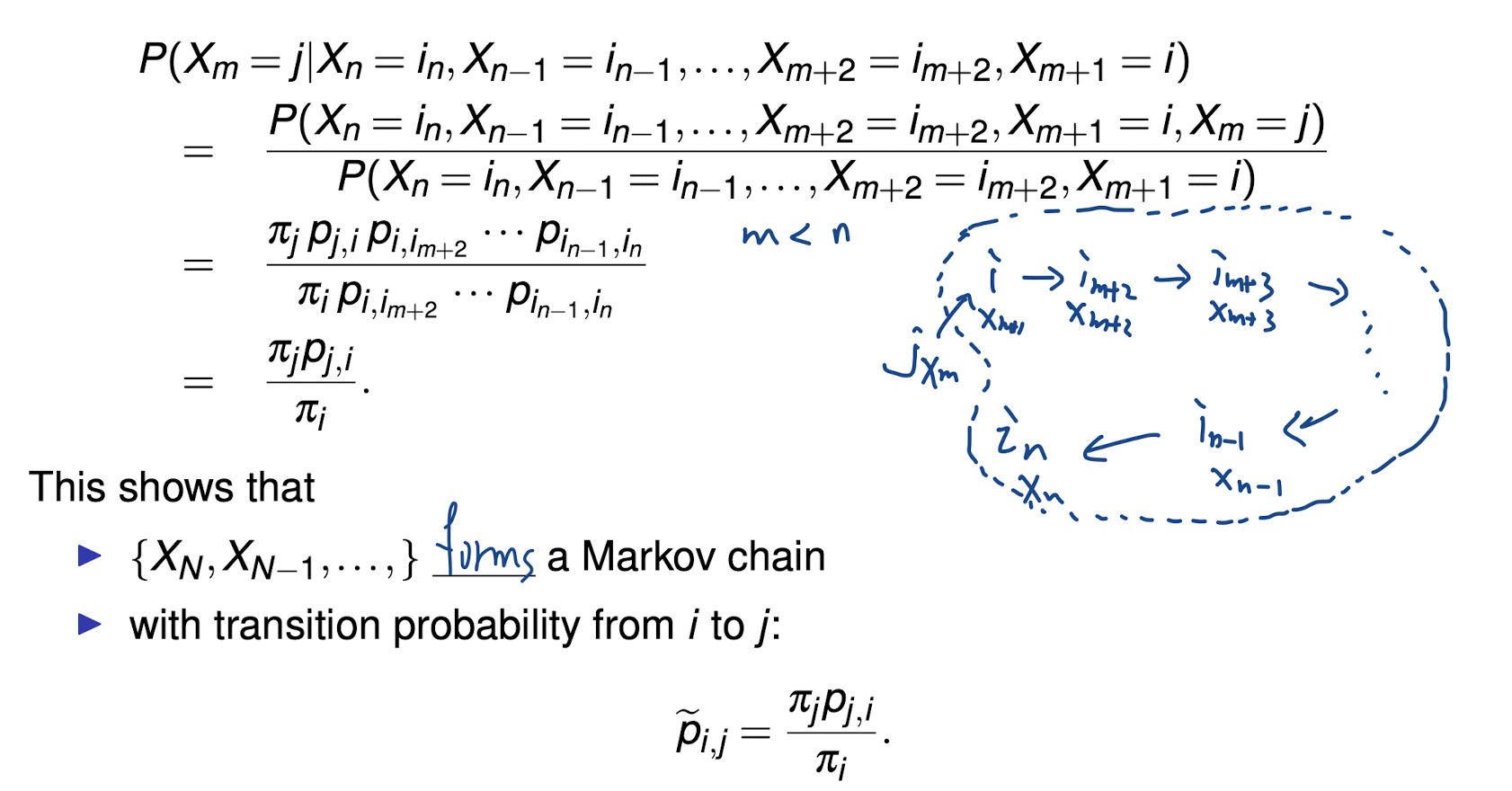
\(\tilde{p}_{i,j}\) is also called dual transition probability.
Detailed Balance Condition
\[\pi_{i} P_{ij} = \pi_{j} P_{ji}\]Balance Condition 其实就很好理解,它的任意两个状态,1 -> 2, 2->1 的概率是一样的,所以它一定满足stationary distribution的条件。
但显然的,stationary distribution 不一定满足 Detailed Balance Condition。
Theorem - Kolmogorov’s criterion for time reversibility
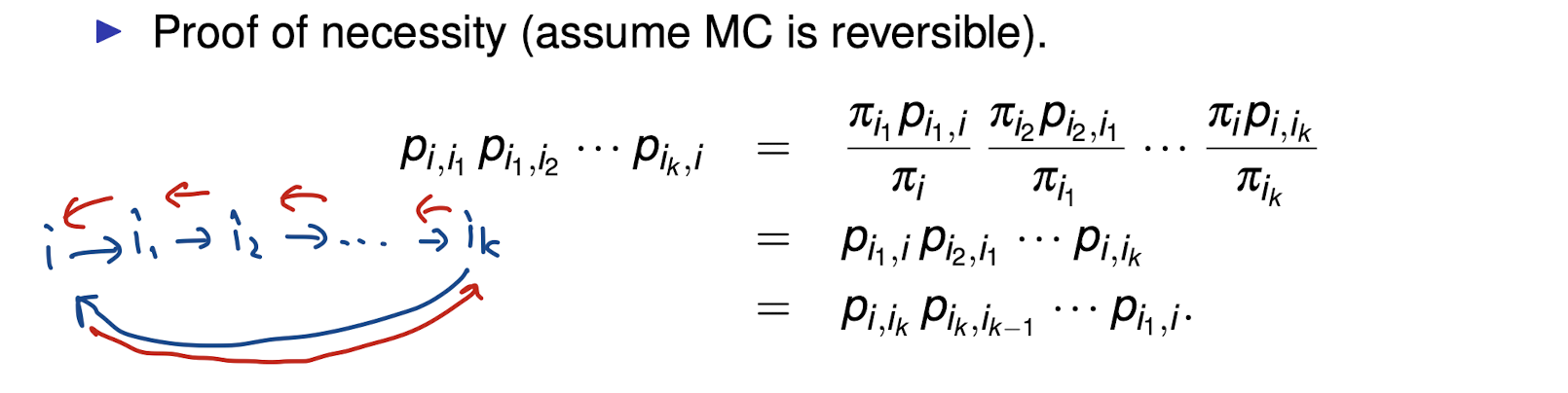
Reversible \( \leftrightarrow \; p_{i,i_1}p_{i_1,i_2} \cdots p_{i_k,i} = p_{i,i_k}p_{i_k,i_{k-1}} \cdots p_{i_1,i}\)
就是说 any path from i to i, the reverse path and the original path probability is equal.
\(\rightarrow\)
\(\leftarrow\)
Generating Function
Notation
\[\begin{align*} p_k &= P(X = k) \\ \phi_X(s)&= \sum_{k= 0}^{ \infty} p_k s^k = E(s^X) \\ p_k &= {\frac{1}{ k!}} \phi_x^{(k)} (0) \text{ k 次导数} \\ \end{align*}\]它的本意是把, 一个 probabilities distribution 转成 power series
还要注意它的定义域, 我们要 \(\sum_{k= 0}^{ \infty} p_k s^k \text{ converge } \Longleftrightarrow |s| \le 1\)
Example
Bernoulli
\[\begin{align*} X &\sim Be(p) \\ P(X = 0) &= 1 - p \\ P(X = 1) &= p \\ \phi_X(s) &= 1-p + p s \\ \end{align*}\]Geometric (直到第一次出现 X = 1)
\[\begin{align*} X &\sim Geom(p) \\ q &= (1-p) \\ \phi_X(s) &= \sum_{k= 0}^{ \infty} s^k P(X=k) = \sum_{k= 0}^{ \infty} s^k p q^{k-1} = ps \sum_{k= 0}^{ \infty} (qs)^{k-1} \\ &= {\frac{ps}{1-qs}} \end{align*}\]Poisson
\[\begin{align*} X &\sim poisson(\lambda) \\ \mathbb{E} ( s^X) &= \sum_{k= 0}^{ \infty} s^k P(X=k)\\ &= \sum_{k= 0}^{ \infty} {\frac{ \lambda^k e^{- \lambda} }{ k!}} s^k &= e^{ - \lambda} \sum_{k= 0}^{ \infty} {\frac{( \lambda e)^k}{k!}} = e^{- \lambda + \lambda k} \end{align*}\]用了 \( e^{x} \) 的泰勒展开 \(e^{x} = 1 + x + {\frac{x^2}{2!}} + ... = \sum_{k= 0}^{ \infty} {\frac{x^k}{k!}}\)
性质
- Convergence: Radius of convergence
- Differentiation
- Uniqueness
For any X, Y 如果 \(\phi_X(s) = \phi_Y(s)\) 那么 \(P(X= k) = P(Y=k) \,\, \forall k = 0,1,2,....\)
- Multiplicative property (If X and Y are independent) \(\phi_{X+Y} = \phi_X (s) \phi_Y (s)\)